
I don’t get a lot of printed furry fiction, mostly because even getting it here is a schlep (and I like to own physical copies) and so many authors post their work for free online. But recently I got hold of The Rains of Vallerane by well-known artist McFan. I’ve enjoyed his work for a long time and even commissioned him a few times, so as a fellow writer (lapsed, derogatory) I was keen to see how his writing felt. “Rains” actually came to my attention not long before the release of the second book, “Sun of Vallerane”, so don’t confuse this for a review of that one. Also, no plot spoilers here beyond what you’d learn anyway from the first few pages or the synopsis.
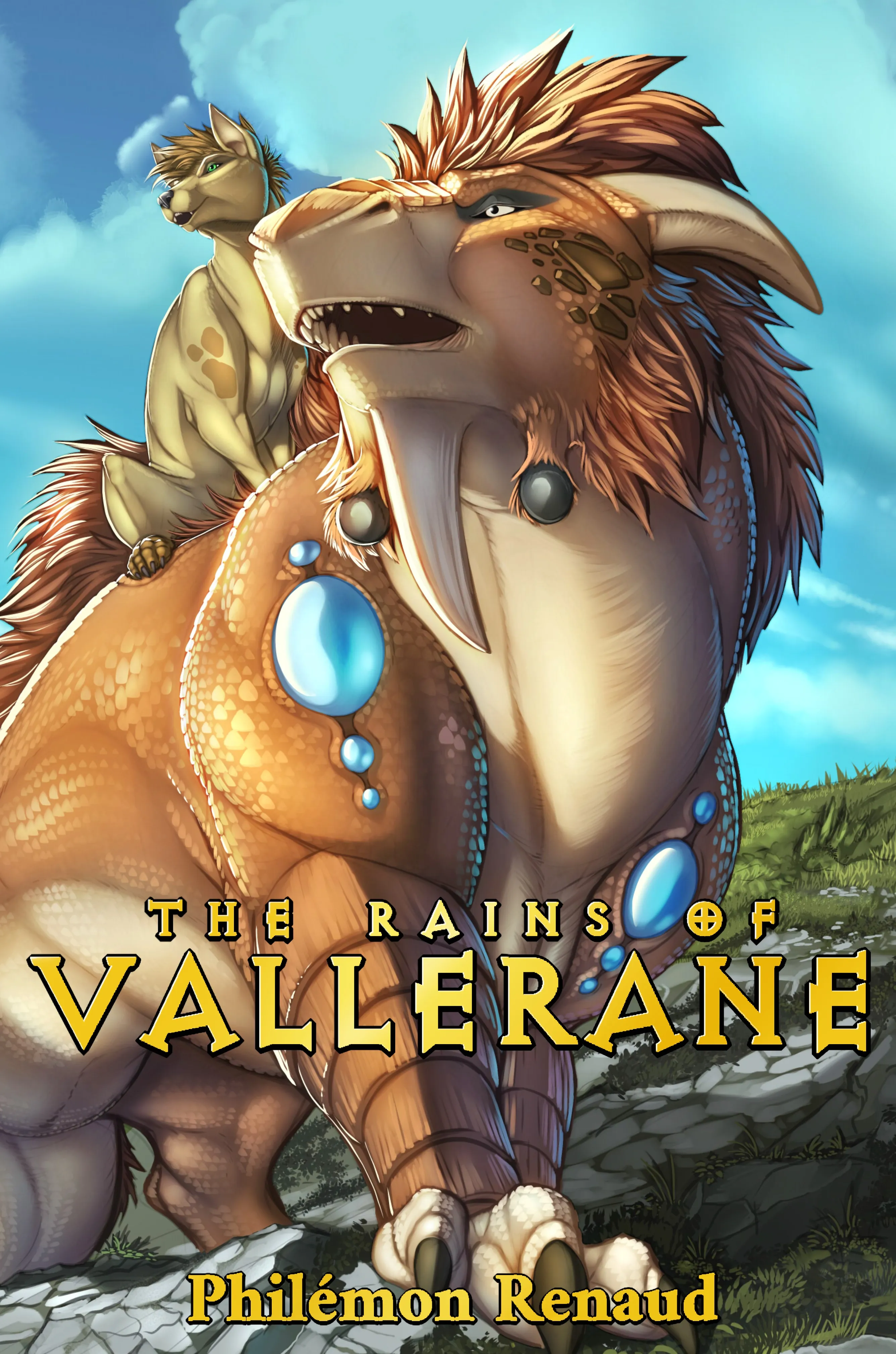
The story follows three main characters: Hayo, a drake of mild temperament who is nonetheless feared in his region for being a terrifying monster; Lahiti, a Recessive (aka. sentient feral) dog who befriended Hayo, and Jona, a mercenary fox who seeks to end the purported tyrannical reign of the region’s drake to prove his worth for a critical mission. Recessives are at best highly disliked in this world, with one country (Lahiti’s own, in fact, before she escaped) described as killing them on sight. As an outcast, she thus easily found common friendship with Hayo, and the two of them have peacefully done their thing for a while. Jona’s arrival throws that into disarray, and the plot kicks off as the three of them seek to satisfy their disparate goals as best they can while dealing with a rapidly-looming threat that could tip the land of Vallerane from merely “in a difficult spot” to “oh shit, oh shit, oh shit”.
The country of Vallerane will be familiar to any furry that picks it up. The species, the mannerisms, the anthro/feral dichotomy is all easy to slip into, even if the terminology is unique at times (eg. “Ascended/Recessive”). At first I thought we might just be seeing the classics like foxes, dog and dragons, but some more interesting species do pop up later in minor roles, which made for some nice variation. Of more interest to me was the writing style, which used emdashes to indicate dialogue lines rather than simply indentation. This is simply because of the fact that the book was originally written in French, where that’s the norm for indicating dialogue, and translated to English after.
I enjoy that they kept the French touch, even if they also added quotation marks to avoid too much confusion for English readers. I also enjoy that the translation wasn’t helped by some big-name company (or, heaven forfend, by some bloody AI) but just by bilingual friends of the author. Every so often I’d tilt my head at an interesting word choice likely made to try to capture the feel of some ineffable French term or idea, and every time it reminded me that this novel is exactly what I love to see the most coming out of the fandom. Absolute works of passion from creators who aren’t American (sorry America, but your huge cultural footprint tends to crush others even if you don’t want it to), made with grit but not polished to some perfect corporate mirror finish. No corporate publisher would ever have kept in emdashes for dialogue in the translation, and any odd word choices would be excised in favour of making it “better”. Except it wouldn’t be better, it would just be the same as every other thing, because profit. As an author with my own novel in the wings, puttering closer to release, I know exactly how much work it takes to finish one of these things—and to then translate it into an entire other language successfully, without also sacrificing your specific voice? An absolute monster achievement. And that’s ignoring the sequel! McFan has clearly put all of himself in this, and I’m so pleased he got to bring his world to life in this way and share it with us all.
The story goes through several twists and turns as we learn more about the three characters, their backstories, the nature of the McGuffin and the people they’ve chosen to surround themselves with. One regret I have is that we didn’t get to spend as much time learning about the places we visit. We get explanations, certainly, but largely (excepting the final location) they are just backdrops for characters to stand in front of. Hayo was a standout character for me, acting more often like a puppy than a huge drake. It made for a good contrast against Lahiti, who due to her life circumstances is more naturally wary and cynical. In fact I almost wish we could have gotten a couple chapters of “The Hayo and Lahiti Show” before Jona entered the picture. We get a bit, but I’d have paid for more for sure. Jona is the unpredictable firecracker of the unlikely threesome, with his challenges driving the plot forward the most. Hayo is wisely involved as well, to ensure he and Lahiti have any reason whatsoever to remain invested, but less than I would have liked. But that’s solely because of how much I liked them as characters. Jona’s plot is just not quite as engaging at first, until later on when additional characters enter the picture to contextualise him more and let us see him taking further action. I also kept waiting to learn more about a mysterious big bad, but he’s clearly going to feature more in the follow-up novels. The final climax deserves a call-out, as that sort of scene is very tricky to write without losing the reader, and I think it was pulled off well.
In the end, Rains of Vallerane was an enjoyable read in a distinct furry universe that I’m pleased to see is expanding further. It has fun characters, quite a few twists (some predictable, some not) and most importantly just a bunch of fun ideas that are interesting to see put together. The pace occasionally lurches forward away from a scene I might have liked to see more of, but apart from more information about the big bad, nothing is left unanswered (a personal bugbear with books that authors intend to become series) and each character gets at least one satisfying “yeah boy” moment. It’s worth your time—and you can go straight into the second book now, too.